2026 Best CPR Training Mannequin for Global Buyers

Time:2026-09-27 Author:Mason
0%

Choosing the 2026 Best CPR Training Mannequin for Global Buyers means looking beyond price and realistic appearance. The right model should help learners practice measurable skills, withstand repeated sessions, and fit the training environment. Small details matter: clear compression feedback, replaceable parts, and stable positioning on a classroom floor.

The American Heart Association’s 2024 Heart Disease and Stroke Statistics Update reports about 356,000 out-of-hospital cardiac arrests annually in the United States. It also reports that roughly 10% of affected people survive to hospital discharge. These figures underline why practice quality matters. A mannequin cannot guarantee better outcomes, but it can help instructors identify shallow compressions, inconsistent rhythm, and incomplete chest recoil. Dr. Ashish Panchal, an emergency physician and resuscitation researcher, captures the training priority: “High-quality CPR is essential.” Buyers should treat that principle as a selection test, not a slogan.

Look closely at the feedback system. Does it show compression depth and rate clearly, or merely flash a light? Check whether the chest offers consistent resistance across repeated compressions. Ask about cleaning, replacement lung bags, language options, and parts availability in the buyer’s region. For blended courses, confirm whether sensors and software work reliably with local devices. Not every buyer needs advanced connectivity. Sometimes, simpler equipment is easier to maintain.

This guide compares practical options for training centers, schools, and workplace programs. It weighs realism, feedback, durability, and total ownership cost. Specifications still need careful checking. A promising product page is not field evidence.
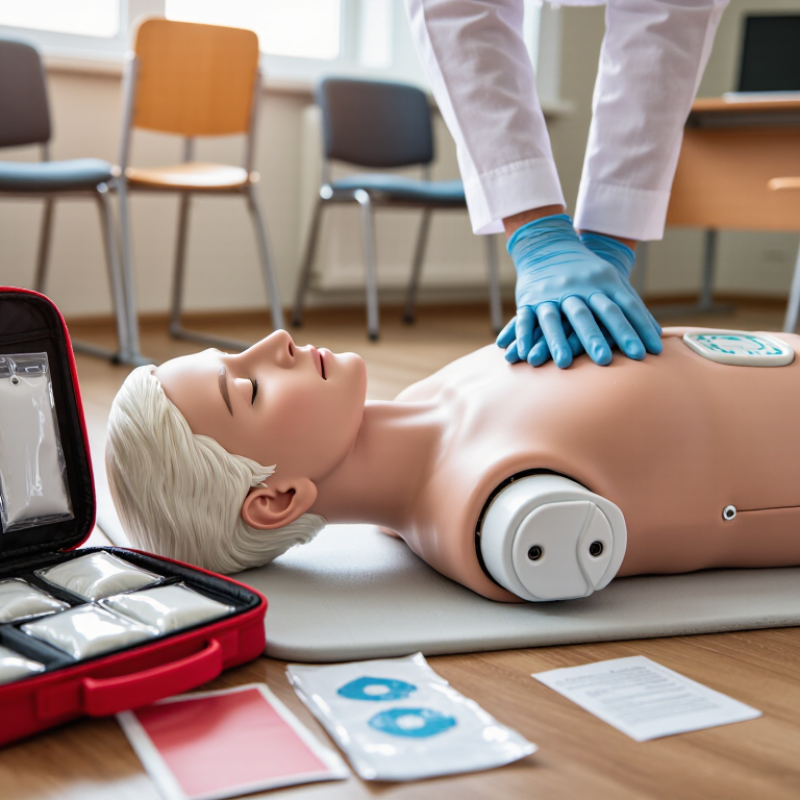
2026 Best CPR Training Mannequin for Global Buyers

What a CPR Training Mannequin Is and How It Supports Skills Practice

A CPR training mannequin is a life-sized or partial-body model used to rehearse chest compressions and rescue breaths. It gives learners a consistent surface for practicing hand placement, compression depth, and rhythm. Some models include lights or indicators that show whether compressions are too shallow, too fast, or poorly positioned. Others use simple mechanical feedback, which can still help instructors spot common errors.

The mannequin also makes repeated practice possible without placing pressure on a real person. Learners can kneel beside it, place their hands at the center of the chest, and follow an instructor’s timing cues. Certain models represent adults, children, or infants, since technique and body size differ across training scenarios. Check that the model suits the intended course and can be cleaned between sessions. Small details matter.

Feedback is useful, but it is not a substitute for skilled instruction. A device may measure compression performance, yet it cannot fully recreate stress, movement, or the uncertainty of an emergency. That limitation is worth remembering. Instructors can combine mannequin practice with clear demonstrations, corrective feedback, and repeated drills. After a session, they should inspect the chest surface, joints, and feedback components for wear. A cracked torso or unreliable indicator can make practice less realistic and reduce confidence in the results.

Main Types of CPR Training Mannequins and Their Features

CPR training mannequins range from simple adult torsos to full-body models with electronic feedback. Basic torsos suit short practice sessions and fit easily on a classroom table. Their chest springs help learners feel compression depth, but they cannot recreate every rescue scenario. No single model fits every class.

Child and infant mannequins let learners practise age-specific hand placement and gentler compressions. Small details matter: a narrow chest, visible landmarks, and a cleanable face shield. Feedback-enabled models add sensors that report compression depth, rate, recoil, or ventilation volume. The 2020 American Heart Association guidelines support feedback devices during CPR skills training. Still, a screen cannot teach calm hands.

For advanced courses, full-body models may support airway practice and coordinated team drills. They need more storage, setup time, and maintenance. Buyers should check whether feedback targets can be adjusted for adult, child, and infant practice.

The CARES 2023 Annual Report recorded 10.4% survival to hospital discharge after EMS-treated out-of-hospital cardiac arrest in its U.S. registry.

That figure is not a mannequin-performance measure; it underscores why realistic, repeatable practice matters. A reassuring score can still hide hesitant learners. Teams should pair device data with instructor observation and routine cleaning checks.

Key Performance Criteria for Comparing Mannequins in 2026

A practical 2026 comparison starts with measurable compression feedback. The American Heart Association’s 2024 Heart Disease and Stroke Statistics report estimates over 356,000 out-of-hospital cardiac arrests occur annually in the United States. About 90% are fatal. That scale makes realistic, repeatable practice important. Compare whether a mannequin reliably measures adult compression depth, rate, and chest recoil. The AHA’s CPR and ECC guidance describes feedback devices as useful in CPR skills training. Check that the displayed readings match current course targets, not just that a screen lights up.

For adult practice, learners need to work toward a compression rate of 100–120 per minute and a depth of at least 5 cm, while allowing full recoil. These targets come from AHA adult CPR guidance. Ask suppliers how sensors are calibrated and whether instructors can review performance after a session. Try the feedback under classroom conditions: a quiet room can make weak audio prompts seem clearer than they are. Accuracy matters.

Also compare cleaning time, replaceable face and airway components, carrying weight, and the availability of child-training configurations. A mannequin used across many classes should withstand repeated kneeling, compressions, and routine cleaning. A limitation is easy to overlook: advanced dashboards do not guarantee better teaching. Check whether exported records are understandable and useful to instructors. No mannequin can reproduce the stress of a real emergency. A hands-on trial may reveal more than a feature sheet.

2026 CPR Training Mannequin Buyer Evaluation Criteria

Suggested evaluation weights for comparing mannequins. These are a buyer-planning framework, not measured market data or a universal standard.

How to use: Prioritize compression feedback and CPR accuracy, then adjust the weights to match your training volume, maintenance capacity, and local procurement requirements. Verify that the mannequin supports feedback aligned with current resuscitation guidance.

How to Assess Safety, Standards, and Regional Requirements

A CPR mannequin should teach the actions learners must perform, not merely look realistic. The American Heart Association’s 2024 Heart Disease and Stroke Statistics update reports more than 356,000 adult out-of-hospital cardiac arrests annually in the United States, with about 10.4% surviving to hospital discharge. That makes reliable practice important. For adult training, check whether feedback measures compression rate and depth against current guidance; AHA guidance specifies 100–120 compressions per minute and at least 5 cm depth, while avoiding depths over 6 cm. Clear visual or audio cues help instructors spot shallow compressions, but feedback should not replace instructor assessment.

Guidance is not product certification. Compare the mannequin’s training functions with current recommendations from the resuscitation council relevant to each destination market. Then confirm local requirements for labeling, language, electrical safety, batteries, cleaning agents, and replacement parts with the importer or competent authority; rules can differ, even between neighboring markets.

Ask for dated test records and the exact standard editions used, rather than accepting a broad “compliant” claim.

A practical check: disinfect the face and chest after a session, then confirm that sensors still respond.

Small details matter. No specification sheet can reveal every classroom problem, and sometimes the best choice is less feature-rich but easier to maintain locally.

How Global Buyers Can Match a Mannequin to Training Needs and Budget

2026 Best CPR Training Mannequin for Global Buyers

How Global Buyers Can Match a Mannequin to Training Needs and Budget

Start with the learners and the skills they must practise. Adult-only courses may need durable torsos, while family, pediatric, or clinical programs require infant or child models and more varied airway practice. The American Heart Association’s 2020 CPR guidelines recommend adult compressions at 100–120 per minute and at least 5 cm deep. A mannequin that gives clear compression feedback can help learners check these targets. Fit matters. The AHA’s 2024 Heart Disease and Stroke Statistics Update estimates about 356,000 out-of-hospital cardiac arrests occur annually in the United States, with roughly 90% fatal. These US figures are not a global measure, but they show why practical training access matters.

Match features to the course, not the longest specification sheet. For large introductory classes, simple, sturdy models may keep practice moving and costs manageable. For assessment or skills refreshers, feedback on rate, depth, and recoil may justify a higher upfront price. Still, electronics cannot replace an instructor’s observation. A mistake buyers sometimes make is comparing purchase prices alone. Check replacement faces, lungs, batteries, cleaning needs, and repair options across the expected service life. Keep it practical. A low-cost model can become expensive if parts are hard to source; a feature-rich one may be underused. Pilot a sample with actual learners before ordering in volume.

FAQS

What is a CPR training mannequin used for?

It lets learners practise chest compressions, hand placement, rescue breaths, rhythm, and chest recoil safely.

What compression targets should adult learners practise?

Aim for 100–120 compressions per minute and at least 5 centimetres deep. Allow the chest to rise fully.

How does feedback improve CPR practice?

Lights, sounds, or mechanical signals can show shallow compressions, excessive speed, or incorrect hand position.

Can feedback replace an instructor?

No. A screen cannot recreate panic, movement, or uncertainty. Human correction still matters.

Should training centres choose adult, child, or infant models?

Choose models matching the course. Adult, child, and infant bodies require different techniques and pressure.

What should buyers inspect beyond the purchase price?

Check replacement faces, airways, lungs, batteries, cleaning time, repairs, and shipping weight. Small parts can become costly.

How can buyers compare mannequin accuracy?

Ask about sensor calibration and stored results. Test readings during a real class, not only in a quiet showroom.

How should a mannequin be maintained between sessions?

Clean contact surfaces and replace used airway components. Inspect joints, indicators, and the chest surface for damage.

Is an advanced mannequin always the better choice?

Not necessarily. A simple, durable model may suit beginners better. Extra features can remain unused.

What limitation should every training centre remember?

Practice is controlled and predictable. Real emergencies are not. That gap deserves honest discussion.

Conclusion

A Cpr Training Mannequin helps learners practise essential CPR skills in a controlled, repeatable way. Different models may be designed for adult, child, or infant training, and can range from simple practice units to options with feedback features that help instructors assess compression depth, rate, and hand placement. Choosing the right type depends on the learners, course format, and skills that need to be taught.

For buyers in 2026, useful comparison points include realism, durability, ease of cleaning, portability, maintenance needs, and the clarity of any feedback system. Buyers should also check that a mannequin is suitable for their training setting and aligns with relevant safety, instructional, and regional requirements. By weighing these factors against class size, expected use, and available budget, training providers can select a practical mannequin that supports effective instruction without paying for features they do not need.


Mason

Mason

Mason is a seasoned marketing professional with a deep expertise in the company's offerings and a passion for driving brand awareness. With a strong background in digital marketing strategies, he has an innate ability to connect with diverse audiences and effectively communicate product benefits.......