Choosing a Medical Simulation Manikin in 2026 requires more than comparing prices and anatomical features. Hospitals, universities, and emergency training centers need equipment that supports measurable learning outcomes. It must also withstand repeated practice, cleaning, transport, and software updates.
A realistic airway, visible chest movement, palpable pulses, and accurate skin tones can improve learner engagement. However, realism alone does not guarantee educational value. A costly manikin may offer impressive graphics but provide limited clinical feedback. Buyers should examine evidence from published studies, manufacturer documentation, and independent user experience.
Look closely at practical details. Can instructors create common trauma scenarios within minutes? Does the system record compression depth, ventilation volume, and response timing? Are replacement parts available in your region? A cracked airway component should not stop a scheduled class.
Ask difficult questions.
Reliable vendors explain limitations clearly. They provide training, technical support, warranty terms, and transparent maintenance costs. Compatibility with existing monitors, simulation software, and audiovisual systems also matters. Data security deserves attention when learner performance is stored or shared.
This guide evaluates leading options through a clinical and operational lens. It considers fidelity, durability, usability, adaptability, total ownership cost, and support quality. Some judgments remain subjective. A pediatric manikin that feels excellent to one instructor may frustrate another during airway practice.
Test before purchasing.
Invite experienced educators, biomedical technicians, and learners to assess the device. Observe setup time, cleaning procedures, feedback accuracy, and physical handling. The best choice is not always the most advanced model. It is the one that consistently supports safe, repeatable, and evidence-informed training.
What Is a Medical Simulation Manikin?
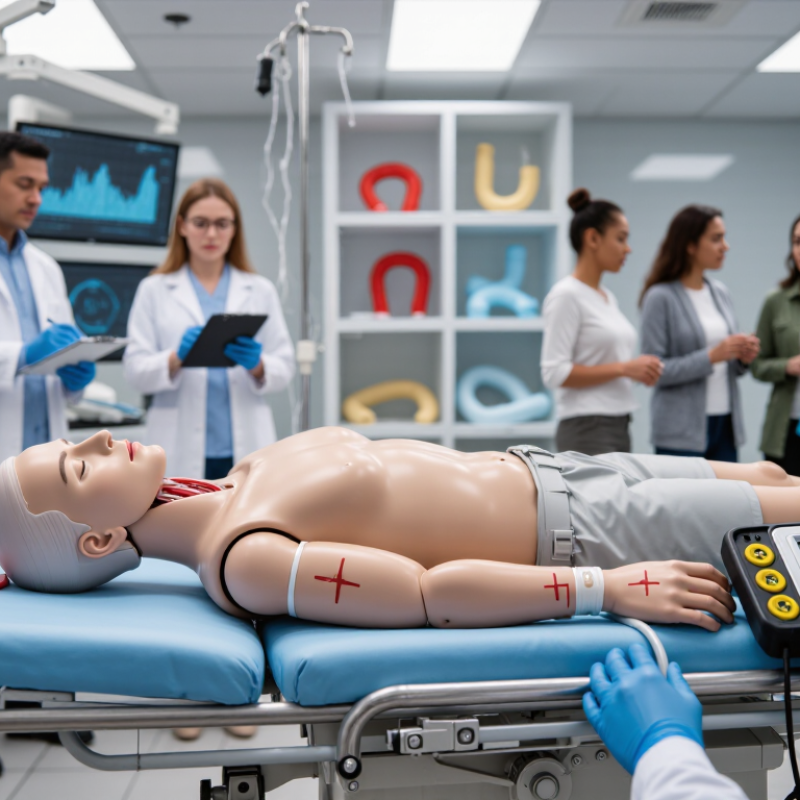
A medical simulation manikin is a life-sized training model that represents part or all of the human body. It helps learners practise clinical skills without placing a real patient at risk. Depending on its design, a manikin may show chest movement, palpable pulses, airway obstruction, bleeding, or changes in vital signs.
It is more than a plastic body. Advanced models include sensors, interchangeable anatomy, realistic skin resistance, and software-controlled responses. In a skills lab, learners might assess breathing, insert a catheter, perform chest compressions, or communicate during an emergency drill. Instructors can pause the scenario, review actions, and discuss safer decisions. Small details matter, such as clear breath sounds, flexible joints, and easy-to-clean surfaces.
From practical experience, the best choice depends on learning goals, maintenance capacity, and available staff. A complex manikin may look impressive but remain underused without trained instructors. A simpler model can teach essential techniques more reliably. No manikin is perfectly human. Its feedback can also be misunderstood. Buyers should check anatomical accuracy, replacement-part access, software support, cleaning requirements, and compatibility with existing equipment. Independent testing, documented training outcomes, and transparent technical specifications provide stronger evidence than attractive demonstrations.
2026 Top Medical Simulation Manikin Buying Guide
What Is a Medical Simulation Manikin?
A medical simulation manikin is a physical patient simulator used to practice clinical assessment, emergency response, procedures, and communication in a controlled environment. The chart shows common adult resting reference ranges that may be programmed or displayed during simulation scenarios. Units differ by vital sign, so the bar lengths should not be compared across categories.
Which Manikin Types Match Different Training Objectives?
2026 Top Medical Simulation Manikin Buying Guide: Which Manikin Types Match Different Training Objectives?
Choosing a manikin should begin with the clinical objective, not the feature list. The WHO Global Patient Safety Report 2024 reports that one in ten patients experiences harm during healthcare. More than half of this harm may be preventable. That finding supports realistic practice for assessment, communication, and emergency response.
For airway management, choose an adult manikin with visible chest rise, airway resistance, and adjustable obstruction. A newborn model suits neonatal resuscitation, thermoregulation, and umbilical assessment. For venipuncture, injections, and catheterisation, task trainers may offer better repetition and lower cost. They isolate one skill clearly. Full-body models support team coordination, deterioration recognition, and escalation decisions. High-fidelity systems add vital-sign changes, voice responses, and medication scenarios. They are useful, but not automatically better.
The 2024 Healthcare Simulation Standards of Best Practice emphasise clear objectives, psychological safety, facilitation, and structured debriefing. A sophisticated manikin cannot replace these elements. That is easy to overlook. Procurement teams should compare anatomical realism, maintenance needs, software reliability, cleaning procedures, and instructor workload. A cheaper model may fit frequent skills practice, while an advanced model may justify its cost for interprofessional crisis training. One imperfect assumption remains: realism does not guarantee learning. The scenario still needs credible timing, trained facilitators, and honest reflection.
How to Evaluate Features, Fidelity, and Clinical Functionality
2026 Top Medical Simulation Manikin Buying Guide
How to Evaluate Features, Fidelity, and Clinical Functionality
A reliable manikin should support measurable clinical practice, not merely look realistic. Check whether learners can assess breathing, pulses, heart sounds, and pupil responses consistently. Test airway access with common devices used in your training environment. Does the chest rise visibly? Can instructors adjust resistance, sounds, and vital signs without interrupting the scenario?
Look beyond appearance. Clinical functionality matters more. Ask for documented testing methods, user training requirements, cleaning procedures, and service response times. A strong system records learner actions, timing, and errors while protecting patient information. Confirm that the software supports your curriculum, from basic assessment to emergency decision-making. Compatibility with existing monitors and training equipment can reduce hidden costs.
Fidelity should match the learning objective. A highly detailed skin texture may add little during a medication safety exercise. Realistic anatomy matters more during airway, injection, or trauma training. It is easy to overvalue visual detail. I would also test setup time, battery life, replacement parts, and reset speed. Slow preparation reduces practice time. That gap matters.
Invite experienced clinicians and simulation technicians to run the same scenario. Compare their observations with the manufacturer’s evidence and published validation data. Do not rely on a polished demonstration alone. A manikin may perform well in a showroom but fail under repeated classroom use. Ask what happens when learners make imperfect decisions, because real training rarely follows a perfect script.
What Technical and Maintenance Factors Should Buyers Consider?
A reliable medical simulation manikin needs more than realistic skin and responsive software. During procurement reviews, examine sensor accuracy, response latency, airway resistance, chest-rise visibility, and wireless stability. The American Heart Association’s 2020 guidelines specify adult compression depth of 5–6 centimeters. Therefore, compression sensors should detect that range consistently, not merely display reassuring scores. Test this with calibrated equipment before purchase.
Maintenance can quietly determine training quality. The World Health Organization reports that one in ten patients experiences harm in healthcare, with more than half considered preventable (WHO Patient Safety Fact File, 2023). Reliable simulation equipment supports safer practice, but only when performance remains stable. Ask for documented cleaning procedures, replacement intervals, software support, battery-cycle expectations, and repair response times. Check whether airway components tolerate repeated use without changing resistance. Small changes matter.
INACSL’s 2024 Healthcare Simulation Standards emphasize equipment readiness, learner safety, and consistent scenario delivery. Buyers should request preventive-maintenance records and a written calibration process. A five-minute startup check can reveal leaking lungs, weak pulses, or failed speakers. Keep spare skin pads and seals onsite. It reduces cancelled sessions.
No checklist is perfect. Some teams overvalue visual realism and underestimate service access. That is a costly mistake. Run a pilot with instructors, technicians, and learners. Record setup time, cleaning time, fault frequency, and data-export accuracy. These observations often expose limitations that sales demonstrations hide.
How to Compare Costs, Suppliers, and Long-Term Value?
2026 Top Medical Simulation Manikin Buying Guide: How to Compare Costs, Suppliers, and Long-Term Value?
A low purchase price can be a false economy. Compare the five-year total cost, not just the invoice. Include consumables, software updates, repairs, warranties, storage, and instructor training. A manikin used twice weekly may create more value than an advanced model used once monthly. Track setup time, failure rates, and cleaning hours. Small delays become expensive across a busy skills laboratory.
The World Health Organization’s State of the World’s Nursing 2020 report projected a global nursing shortage of 4.6 million by 2030. That pressure makes repeatable, measurable training increasingly important. Ask suppliers for documented uptime, replacement-part availability, response times, and references from comparable institutions. Request a live demonstration using your scenarios, not a scripted showroom case. Review data protection and maintenance responsibilities clearly.
The 2024 Healthcare Simulation Standards of Best Practice emphasize learning objectives, prebriefing, debriefing, and qualified facilitation. A realistic chest rise is useful, but it cannot replace sound teaching. I would also score clinical relevance, repairability, and curriculum compatibility. My comparison would not be perfectly objective; staff preferences can distort the result. A simple weighted matrix helps expose that bias. Measure performance after six and twelve months, because impressive first impressions can fade quickly.
FAQS
It is a life-sized training model representing part or all of the human body. Learners practise clinical skills without risking a real patient. It is not a real person.
Depending on its design, it may show chest movement, pulses, airway obstruction, bleeding, or changing vital signs. Some models provide breath sounds, heart sounds, pupil responses, and flexible joints. Small details matter.
Choose realistic anatomy for airway, injection, trauma, or assessment training. Detailed skin texture may add little during medication safety practice. Appearance can mislead.
Test airway access, visible chest rise, resistance, sounds, and vital-sign controls. Also check setup time, reset speed, battery life, cleaning needs, and replacement parts. Slow preparation reduces practice time.
Complex technology cannot replace clear objectives, prebriefing, debriefing, and qualified facilitation. Instructors should pause scenarios, review actions, and discuss safer decisions. Without training, expensive equipment may remain unused.
Calculate the five-year total cost, including consumables, software updates, repairs, storage, warranties, and instructor training. Track cleaning hours, failure rates, setup delays, and equipment uptime. Small delays become expensive.
Request documented testing methods, service response times, replacement-part access, and comparable user references. Ask for a live demonstration using your own scenarios. Showrooms can flatter equipment.
Use a weighted comparison matrix covering clinical relevance, repairability, compatibility, and maintenance. Invite clinicians and simulation technicians to assess the same scenario. My judgment may still be imperfect.
Review performance after six and twelve months, not only during installation. Measure learner outcomes, equipment uptime, reset speed, and repeated classroom use. Initial impressions fade.
Conclusion
A Medical Simulation Manikin is a training model designed to help healthcare learners practice clinical skills in a controlled and repeatable environment. This guide explains how different manikin types support specific objectives, from basic anatomy and physical assessment to advanced emergency response, airway management, childbirth, and patient-care procedures. Selecting the right model depends on learner level, curriculum goals, realism requirements, and the range of skills that must be practiced.
Buyers should evaluate anatomical accuracy, movement, feedback, clinical functions, software compatibility, and the quality of available training scenarios. Technical considerations include setup, connectivity, cleaning, storage, durability, replacement parts, software updates, and staff training. Cost comparisons should look beyond the purchase price by considering warranties, maintenance, accessories, expandability, supplier support, and expected service life. A carefully selected manikin can improve training consistency, reduce long-term expenses, and deliver stronger educational value.

 Guanbang Medical